
Definition
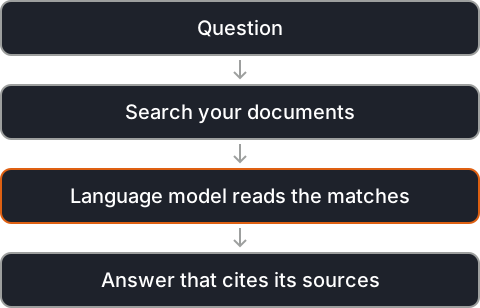
Retrieval-augmented generation (RAG) is a way to make a language model answer from your own material. When someone asks a question, the system first searches your documents for the passages that match it, then gives only those passages to the model as context.
The model writes its answer from that context, so the reply stays close to your sources and can point to the document it came from. When the documents change, the answers change with them, without retraining the model.
A RAG assistant is a good fit when the knowledge already exists in writing but is hard to find. It is less useful when the answers depend on judgement that nobody has written down.
Applications
- Internal questions about policies, HR rules and processes.
- A support knowledge base that agents or customers can ask in plain language.
- Search across product manuals and technical documentation.
- Finding clauses and facts across contracts and other long documents.
- Onboarding, so new staff can ask instead of hunting through folders.
Well-known tools
Tools that are widely used for this kind of work, given as examples from the field. The right choice depends on your data, your systems and where the solution has to run.

DeepSeek
Open models

Qwen
Open-weight LLMs

Hugging Face
Model hub

llama.cpp
LLM inference

Ollama
Local LLMs
- LlamaIndex: a framework for indexing documents and retrieving them for a model.
- LangChain: a framework with building blocks for retrieval and model calls.
- pgvector: vector similarity search inside PostgreSQL.
- Qdrant: an open-source vector database.
- Elasticsearch: a search engine that combines keyword and vector search.
Real-world problems
Knowledge is scattered
Answers sit in shared drives, wikis, chats and inboxes, and people spend time searching or asking a colleague.
Different people give different answers
When everyone works from memory, the same question gets several answers. Grounding replies in one set of documents keeps them consistent.
Outdated documents
Old versions keep being used. A RAG index can be refreshed when a document changes, so answers follow the current version.
Who may see what
Not every document is for everyone. Retrieval can respect access rights, so people only get answers from what they are allowed to read.
Made-up answers
A model on its own may invent facts. Showing the source passage lets people check an answer before they rely on it.