
Definition
An AI agent is a language model that works towards a goal instead of only replying with text. It can call tools you give it: read from a database, search a system, update a record or send a message.
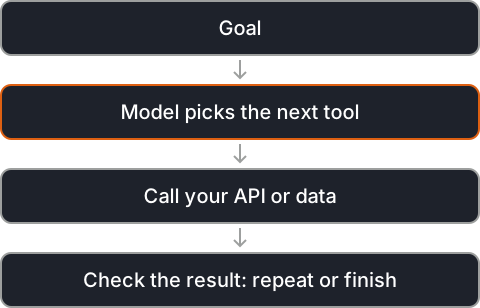
The agent runs in a loop. It decides the next step, calls a tool, looks at the result and either continues or stops. Clear limits decide which tools it may use and which actions need a person to approve them first.
Agents fit work that follows a pattern but still needs some reading and deciding: a request comes in, the right data is looked up, a few systems are updated. Simple fixed rules are often better handled by plain automation.
Applications
- Updating a CRM from emails, calls or forms.
- Sorting support tickets and drafting first replies for a person to review.
- Building a report from data held in several systems.
- An internal assistant that can look things up and carry out routine requests.
Well-known tools
Tools that are widely used for this kind of work, given as examples from the field. The right choice depends on your data, your systems and where the solution has to run.


- Claude Agent SDK: Anthropic's toolkit for building agents on the loop behind Claude Code.
- OpenAI Agents SDK: a Python framework for agents with tools, handoffs and guardrails.
- LangGraph: a framework for agents as stateful graphs of steps.
- Pydantic AI: a Python agent framework with typed inputs and outputs.
Real-world problems
Copying between systems
Staff move the same data by hand from one tool to another. An agent can read it in one place and write it in the next.
Slow first responses
Requests wait in a queue until someone has time to read them. An agent can sort them and prepare a draft straight away.
Keeping control
Automation that acts on its own is a risk. Agents can be limited to safe tools, log every step and ask before anything that cannot be undone.