
Definition
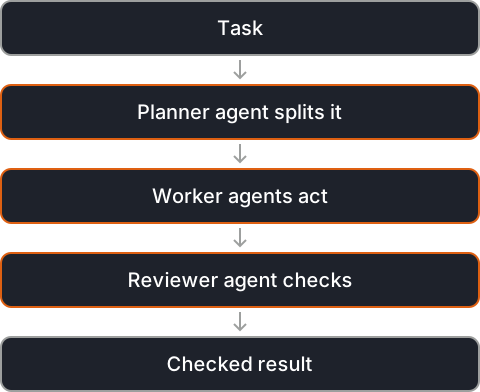
An agentic system splits a large task between several agents with separate roles. A planner breaks the work into steps, worker agents carry them out, and a reviewer checks the results before they move on.
An orchestrator passes work between them and keeps the shared state. Because each agent has a narrow job and its own instructions, long tasks stay on track and mistakes are caught between steps instead of at the end.
This extra structure is worth it for work that is too long or too varied for one agent. For short, single-step requests, one well-instructed agent is usually simpler, faster and cheaper to run.
Applications
- Research and writing pipelines, where one agent gathers sources and another drafts.
- Code migration or refactoring across many files.
- Document review with a separate checker agent.
- Long back-office tasks with many steps and hand-offs.
Well-known tools
Tools that are widely used for this kind of work, given as examples from the field. The right choice depends on your data, your systems and where the solution has to run.


- LangGraph: a framework for coordinating several agents as a graph.
- CrewAI: a framework for teams of role-based agents.
- OpenAI Agents SDK: a framework with handoffs between agents.
Real-world problems
One agent loses track
On long tasks a single agent forgets earlier steps or drifts from the goal. Separate roles keep each part small and focused.
Errors that compound
A wrong step early on spoils everything after it. A reviewer agent between steps catches problems while they are still cheap to fix.
Cost and speed
Many model calls add up. Choosing the right model for each role and running independent steps in parallel keeps cost and waiting time down.
Knowing who did what
With several agents, a clear log of each step and decision is what makes the system easy to trust and debug.